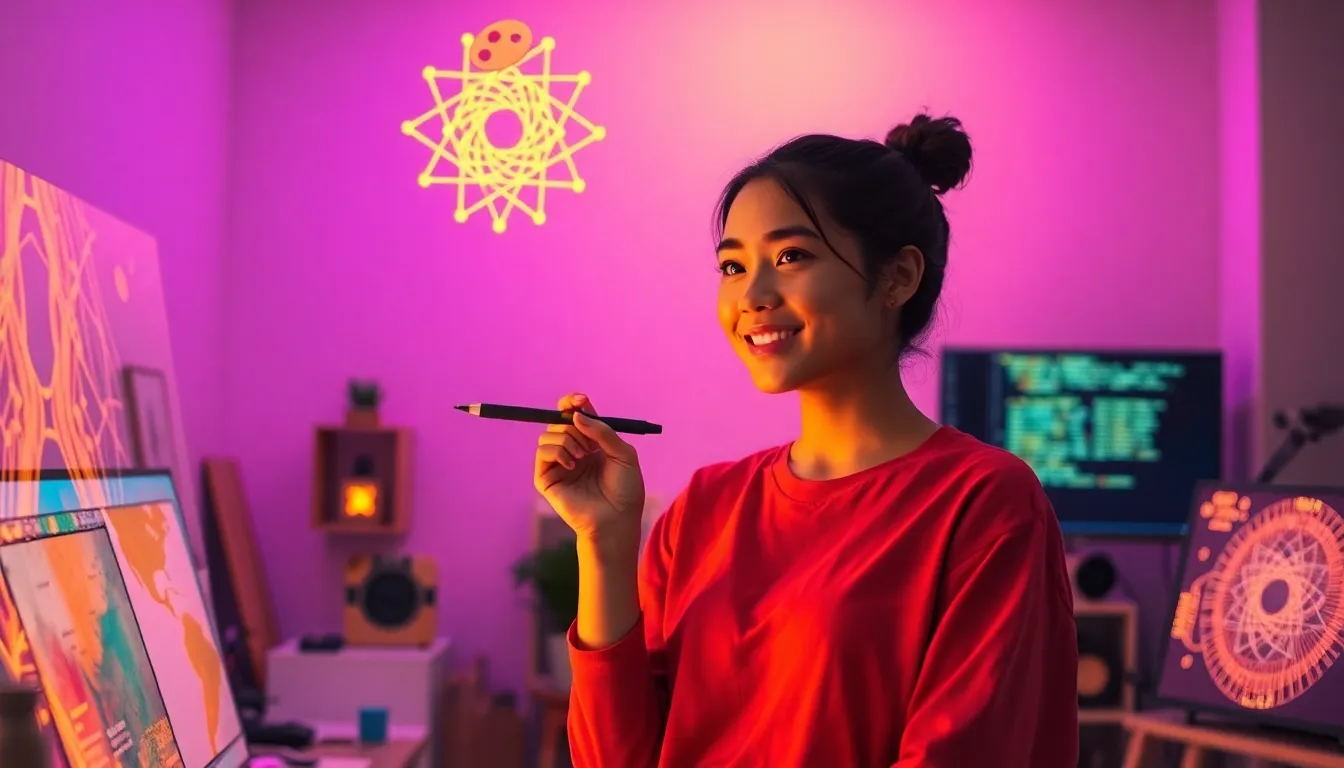
AI and the Arts: A New Creative Landscape
It’s sort of wild to think about, isn’t it? Artificial intelligence, this thing that used to feel like pure science fiction, is now actively involved in making art. Paintings, music, stories – AI is chiming in on all of it. We’re not just talking about tools that help artists work faster; we’re talking about AI systems that can generate entirely new creative outputs. This isn’t just a fleeting trend; it feels like a genuine shift in how art can be made and what we consider creative. Of course, it brings up a lot of questions, doesn’t it? Like, what does this mean for human artists? Is AI a collaborator, a tool, or something else entirely? And where does originality fit into this picture? It’s a lot to wrap your head around, but honestly, it’s also incredibly exciting. We’re seeing art forms develop in ways we couldn’t have predicted, and that, in itself, is pretty fascinating. Let’s try to explore what this looks like right now, some of the cool things happening, and maybe some of the tricky bits too.
AI as a Creative Partner: Beyond the Brush
So, how does AI actually get involved in art? It’s not like a computer suddenly decides to pick up a paintbrush. Usually, it starts with data. AI models, especially the ones used for creative tasks, are trained on massive datasets of existing art – think millions of images, songs, or texts. The AI learns patterns, styles, and relationships within that data. Then, when you give it a prompt – like “a Van Gogh painting of a cat in space” or “a melancholic jazz piece inspired by rain” – it uses what it learned to generate something new. It’s a bit like a very sophisticated remixer, but with a capacity for emergent creativity. You might be thinking, “Is that really creativity, though?” Well, that’s part of the debate. Some see it as derivative, simply rearranging existing elements. Others argue that the way AI combines concepts and styles in unexpected ways can be genuinely novel and surprising.
Let’s look at some practical examples. For visual art, tools like Midjourney, Stable Diffusion, and DALL-E 2 have exploded in popularity. Anyone can type in a description, and within seconds, get a series of images. Some artists are using these tools as a starting point, generating initial concepts or textures that they then rework and integrate into their traditional art. Others are pushing the boundaries of AI art itself, creating complex, surreal, or photorealistic images that could never exist in the real world. In music, AI can compose original scores, generate background tracks, or even create new instrumental sounds. Companies are using AI to create personalized soundtracks for videos or games. For writers, AI can help brainstorm plot ideas, write character descriptions, or even draft entire passages of text. Think about AI writing assistants that can suggest alternative phrasing or help overcome writer’s block. What people sometimes get wrong is thinking the AI is doing all the work on its own. To get really interesting results, you still need to learn how to prompt effectively, understand the AI’s capabilities and limitations, and often, you need a human artist’s eye to curate, edit, and refine the output. It’s a collaboration, really. Common tools are becoming more accessible, lowering the barrier to entry, which is exciting but also leads to a flood of content – making it harder for unique voices to stand out. Where it gets tricky is when the AI’s output starts looking too similar, or when the “prompt engineering” becomes the main skill, overshadowing artistic intent. Small wins can be generating an image that perfectly captures a bizarre idea, or composing a melody that evokes a specific emotion you were aiming for.
The Shifting Definition of Artistry and Authorship
This rise of AI in creative fields forces us to ask some pretty deep questions about what it means to be an artist and who “owns” the art. If an AI generates an image based on a prompt from a human, who is the artist? Is it the person who wrote the prompt, the developers who created the AI, or the AI itself? This is a legal and philosophical minefield, and frankly, nobody has all the answers yet. Copyright law, for instance, typically requires human authorship. So, can AI-generated art be copyrighted? Some initial rulings have said no, but the landscape is evolving. What people often get wrong is assuming authorship is a simple, clear-cut thing. In reality, it’s becoming much more complex. It’s not just about the technical skill of painting or composing; it’s about the conceptualization, the curation, the intent, and the vision. And AI throws a huge curveball into all of that.
Think about it this way – a photographer uses a camera, a tool. A composer uses instruments and software. Is an AI just another, albeit more complex, tool? Or is it a co-creator? Where it gets tricky is when the AI’s output is so sophisticated that it’s hard to distinguish from human work, and when the AI seems to exhibit a form of “style” or “decision-making” that feels like intent. For example, an AI image generator might consistently produce images with a certain atmospheric quality, even without being explicitly prompted to do so. Is that a learned stylistic tendency, or something more? Some artists are embracing this ambiguity, using AI to explore themes of authorship and consciousness in their work. They might deliberately create art that blurs the lines between human and machine creation. Common challenges include the sheer volume of AI-generated content making it difficult to find genuinely original or impactful pieces. Another challenge is the ethical implication of AI being trained on existing artists’ work, sometimes without their explicit consent or compensation. Small wins here involve artists finding ways to use AI to express their unique vision more powerfully, or to explore new conceptual territories that wouldn’t be accessible otherwise. It’s about using the AI to amplify your own artistic voice, not just to generate pretty pictures.
Navigating the Challenges and Opportunities
Like any major technological shift, AI in the arts comes with its own set of challenges, but also, frankly, a lot of exciting opportunities. One of the biggest concerns, honestly, is around job displacement and the economic impact on human artists. If AI can generate content faster and cheaper, what does that mean for illustrators, graphic designers, musicians, and writers who make their living from these skills? It’s a valid worry. We’re seeing some industries already experimenting with AI-generated content for things like stock imagery or background music, which could reduce the demand for human creators in those specific niches. Where it gets tricky is finding the right balance – how do we ensure human artists can still thrive and be compensated fairly in a world where AI can produce art so readily?
However, there are also huge opportunities. AI can be an incredible tool for creative exploration. For someone who can’t draw, AI can help them visualize their ideas. For a musician struggling with writer’s block, AI can provide melodic or harmonic suggestions. It can democratize creativity, allowing more people to express themselves visually or musically. Think about AI-powered tools that can help you learn new artistic techniques faster, or that can generate variations on your work, giving you more options to explore. What people often get wrong is viewing AI as a complete replacement for human creativity. Instead, it’s more useful to think of it as an augmentation. The most exciting applications often involve humans and AI working together, with the AI handling repetitive tasks or generating raw material, and the human providing the vision, curation, and refinement. Common challenges include the learning curve for these new tools and the ethical questions we’ve touched on – like intellectual property and fair use. To start, perhaps just experiment. Play with free AI art generators or music composition tools to get a feel for what they can do. Small wins could be generating a character design you love, or composing a short jingle that captures a mood. These early successes can build confidence and lead to more ambitious projects, showing you how AI can actually expand your creative possibilities, rather than just replace them.
Quick Takeaways
- AI is actively creating art – visual, musical, and written.
- It learns by analyzing massive datasets of existing creative works.
- Prompting is a new skill, but human vision and curation remain vital.
- Authorship and copyright are complex, evolving issues with AI art.
- AI can democratize art creation but also raises concerns for human artists’ livelihoods.
- Think of AI as a collaborator or advanced tool, not just a replacement.
- Experimentation is key to understanding and using AI in your own creative process.
So, what’s the main thing to remember from all of this? Honestly, it’s that AI isn’t just some distant future technology; it’s here, and it’s fundamentally changing the landscape of art and creativity right now. It’s not about AI taking over from human artists, though there are definitely challenges to navigate regarding jobs and compensation. Instead, it’s more about a new kind of partnership emerging. Think of it like photography arriving and changing painting – painting didn’t disappear, it evolved. AI is likely to do something similar for many art forms. The tools are becoming more accessible, which means more people can experiment and create in ways they couldn’t before. This is exciting, but it also means we need to think harder about originality, authorship, and the value we place on human skill and intent. Where this leads is still uncertain, but it’s clear that the future of art will involve a dynamic interplay between human imagination and artificial intelligence. It’s a space ripe for exploration, for artists willing to adapt and for audiences willing to engage with new forms of expression. The conversation is just beginning, and it’s going to be a fascinating one to follow, with plenty of room for both human and machine-generated creativity to coexist and perhaps even inspire one another in ways we haven’t even imagined yet. The real magic, it seems, will lie in how we humans choose to guide and collaborate with these powerful new tools.